

Should-cost modeling is a bottom-up methodology used to calculate the true cost of producing a capital asset based on raw materials, direct labor, manufacturing overhead, logistics, and a reasonable profit margin. Instead of accepting a vendor quote at face value, a cost analysis establishes an objective commercial benchmark. Most industrial capital equipment buyers negotiate blind because they evaluate top-down quotes without knowing what the equipment actually costs to manufacture.
What Is Should-Cost Modeling?
Cost modeling means building a mathematical representation of a product or asset’s cost structure based on its underlying financial and physical drivers. What should cost modeling be in the context of capital procurement? It is the practice of reconstructing a piece of equipment’s cost profile from the ground up rather than accepting a supplier’s top-down price tag.
When a supplier submits a quote for a custom industrial mixer, cleanroom air handler, or automated packaging line, their proposed price reflects their desired margin, internal inefficiencies, and prevailing market demand. A bottom-up cost model strips away those subjective assumptions. By analyzing baseline raw material quantities, required machining hours, current labor rates, and factory overhead, the model calculates what the asset ought to cost under efficient manufacturing conditions. This provides executive decision-makers with a clear, defensible target price before signing high-value purchase orders.
What Goes Into a Should-Cost Model
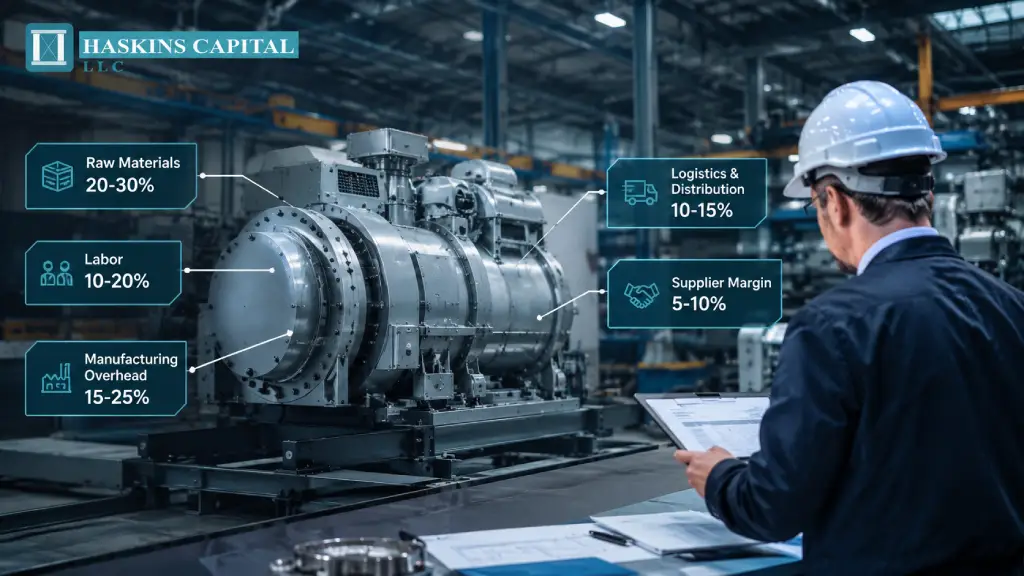
Building an accurate cost model requires evaluating the fundamental cost drivers of manufacturing without getting bogged down in unnecessary technical complexity. The primary components include:
- Raw Materials and Sub-components: The physical inputs required to fabricate the asset, calculated using current commodity spot prices and bill of materials estimates.
- Direct Labor: The hands-on engineering, welding, machining, assembly, and testing hours necessary to build the equipment, multiplied by regional trade labor rates.
- Manufacturing Overhead: Factory operational costs, including equipment depreciation, facility power, indirect supervision, and tooling wear required during production.
- Logistics and Landed Expenses: Freight, specialized packaging, import tariffs, port fees, and heavy-haul transport required to deliver the asset to your site.
- Supplier Margin: A fair, market-aligned profit allowance, typically ranging from eight to fifteen percent depending on market conditions and equipment complexity.
How to Do a Should Cost Analysis
Executing a rigorous cost analysis requires a structured process that translates technical specifications into commercial leverage during procurement.
First, gather the primary technical parameters. This includes general arrangement drawings, equipment duty specifications, material grades, overall dimensions, and major bought-out sub-components like motors or pumps. High-level engineering data is entirely sufficient to establish a reliable baseline.
Second, map the primary cost drivers. Identify which elements represent the majority of the equipment value. In heavy structural equipment, raw steel and plate fabrication drive the total cost. In automated processing units, specialized controls and precision components dominate the budget.
Third, apply current market rates. Input verified commodity pricing, regional trade labor rates, and standard fabrication cycle times into your calculation framework. This grounds the model in real-time commercial data rather than historic vendor pricing.
Fourth, aggregate the cost stack and calculate a target price. Combine the material, labor, overhead, and logistics elements, then apply an appropriate supplier profit margin.
Finally, compare your target result to the vendor quote to identify commercial gaps. While a simplified shoulder cost model template can assist with standard purchases, complex capital equipment requires tailored calibration to account for specialized manufacturing constraints.
Should-Cost Analysis vs. Should-Cost Modeling: Is There a Difference?
Industrial buyers frequently ask about the distinction between these two terms. What should cost analysis be compared to modeling? In practice, they refer to the exact same commercial discipline.
The distinction lies entirely in the relationship between the tool and the process. Should-cost modeling refers to the quantitative activity of building the financial model, inputting data, and calculating the baseline numbers. Should-cost analysis is the broader strategic process of interpreting those outputs, evaluating vendor proposals against the baseline, and using the findings to drive procurement negotiations.
Should-Cost Modeling in Procurement: Why It Matters for Capital Equipment
Applying a cost model procurement strategy is uniquely vital when sourcing capital equipment across industrial manufacturing, food and beverage processing, pharmaceutical facilities, and data centers. Unlike routine direct materials or high-volume consumable parts, capital assets are purchased infrequently. A company expanding a facility or building a new processing plant may buy major equipment only once every few years.
This low purchase frequency creates a massive information asymmetry. Equipment suppliers negotiate capital contracts every day, while corporate project teams execute major capital builds periodically. Without a dedicated procurement cost analysis, project owners default to comparing vendor quotes against each other or against past project budgets.
Neither method tells you if the price is fair. Vendor quotes in competitive bids often cluster around the same inflated baseline if suppliers share similar margin expectations or market conditions. Furthermore, historical project data becomes obsolete quickly due to inflation, volatile commodity prices, and shifting supply chain dynamics. Using bottom-up cost modeling ensures that project owners maintain financial control over custom, high-dollar purchases.
The Problem With Doing This In-House
Most enterprise organizations lack the internal infrastructure required to perform bottom-up cost modeling for capital equipment. Building this capability in-house presents several major operational hurdles.
First, specialized cost modeling software requires significant capital investment, often costing tens of thousands of dollars in annual licensing fees. More importantly, these software platforms are designed for engineering teams working with detailed CAD files, requiring specialized full-time operators to generate meaningful outputs.
Second, internal engineering and procurement teams rarely have access to real-time, independent benchmark data for regional fabrication labor rates, factory overhead multipliers, or current equipment component pricing.
Third, capital projects operate under strict time constraints. Project managers and procurement leaders rarely have the weekly bandwidth to build complex cost models from scratch while simultaneously managing contractor RFPs, site logistics, and project schedules. Paying for expensive software or trying to force overburdened internal teams to master complex modeling tools creates unnecessary overhead. Most companies do not need another software subscription; they need targeted, practitioner-led advisory support that delivers immediate savings without adding internal payroll.
Should-Cost Modeling and Supplier Negotiation
Deploying a should-cost model completely transforms the dynamics of vendor negotiations. Without bottom-up cost data, price discussions inevitably devolve into subjective bargaining. Buyers ask for arbitrary discounts, and suppliers claim their margins are already razor-thin.
Conducting a formal supplier cost breakdown analysis shifts the conversation from opinion to verifiable commercial facts. Rather than making a generic request for a five percent price reduction, project owners can present specific line-item findings.
For example, if a supplier allocates forty thousand dollars to structural welding labor on a vessel build, but verified labor standards and regional wage rates indicate the work requires twenty-two thousand dollars, you have a concrete talking point. The supplier must either justify their specific labor hour assumptions or adjust their pricing to match realistic market conditions.
This approach eliminates contentious, emotional negotiations. It signals to suppliers that your organization understands their manufacturing process and will not pay unearned premiums or unvetted overhead markups.
When to Bring In a Should-Cost Advisor
Not every minor equipment purchase warrants a full bottom-up cost audit. However, specific project triggers indicate when bringing in an independent owner-side advisor delivers a substantial return on investment.
You should consider external advisory support when:
- Executing major capital projects or facility expansions exceeding one million dollars in equipment spend.
- Sourcing custom, non-standard machinery where market pricing is opaque and competitive bidding is limited.
- Negotiating with single-source or sole-source vendors who refuse to provide itemized cost breakdowns.
- Facing cross-border procurement challenges with overseas original equipment manufacturers.
- Lacking dedicated internal procurement analysis resources or missing real-time commodity benchmark data.
An experienced owner-side advisory partner can review equipment proposals, build independent should-cost models, and identify unearned contractor margin before commitments are signed.
Frequently Asked Questions
What are the 4 cost principles?
The four fundamental cost principles in procurement and accounting are direct costs, indirect costs, fixed costs, and variable costs. Direct costs tie directly to product manufacturing, indirect costs cover operational overhead, fixed costs remain constant regardless of production volume, and variable costs fluctuate based on output.
What are the 4 methods of cost estimation?
The four primary methods of cost estimation are analogy estimation, parametric estimation, engineering bottom-up estimation, and expert judgment. Bottom-up engineering estimation is the most accurate approach for building reliable should-cost models for capital equipment.
Should cost model example?
A typical capital equipment should-cost model breaks down a custom machine into raw steel tonnage, buy-out component costs such as motors and gearboxes, direct machining and assembly hours, factory overhead rates, freight costs, and a standard twelve percent supplier profit margin to establish a true target price.