

A procurement consultant is an independent commercial expert who evaluates how an enterprise acquires goods, equipment, and contracted services to reduce costs, mitigate risk, and enforce financial governance. Rather than relying on supplier quotes or generic contract templates, organizations engage procurement advisory services to audit spending, benchmark vendor pricing, and protect capital allocations during major purchasing decisions.
Procurement Consultant Meaning: The Short Definition
The procurement consultant meaning centers on objective commercial governance: a specialized advisor hired to audit acquisition processes, negotiate contracts, and eliminate unearned supplier margins. In practice, a procurement consultant acts as an independent bridge between engineering requirements and corporate financial management. They ensure that every purchase order, vendor agreement, and contractor invoice aligns with true market values rather than supplier-dictated terms.
What Does a Procurement Consultant Do?
The primary procurement consultant role is to safeguard enterprise capital by establishing cost control and contract transparency across the purchasing lifecycle. While daily activities vary depending on whether an organization needs end-to-end procurement consultants or targeted risk audits, core duties fall into three main areas of commercial execution.
Spend & Contract Analysis
A consultant audits historical spending patterns, category pricing, and existing vendor contracts to identify unearned costs and exposure points. By analyzing line-item unit rates against verified market benchmarks like RSMeans and commodity spot prices, the consultant uncovers hidden margins and pricing discrepancies before contract execution.
Vendor & Contract Negotiation
Consultants lead or support vendor negotiations using bottom-up cost data rather than arbitrary discount requests. They redline commercial terms in contractor agreements to lock in firm pricing, define clear scope boundaries, and remove open-ended cost escalation clauses.
Cost Control on Active Projects
During active execution, consultants manage financial governance by auditing contractor change order submissions and verifying progress payment requests. They ensure change orders reflect actual field scope rather than inflated builder margins, and verify physical work-in-place before pay applications are authorized.
Procurement Consultant Role vs. Procurement Consulting Firm
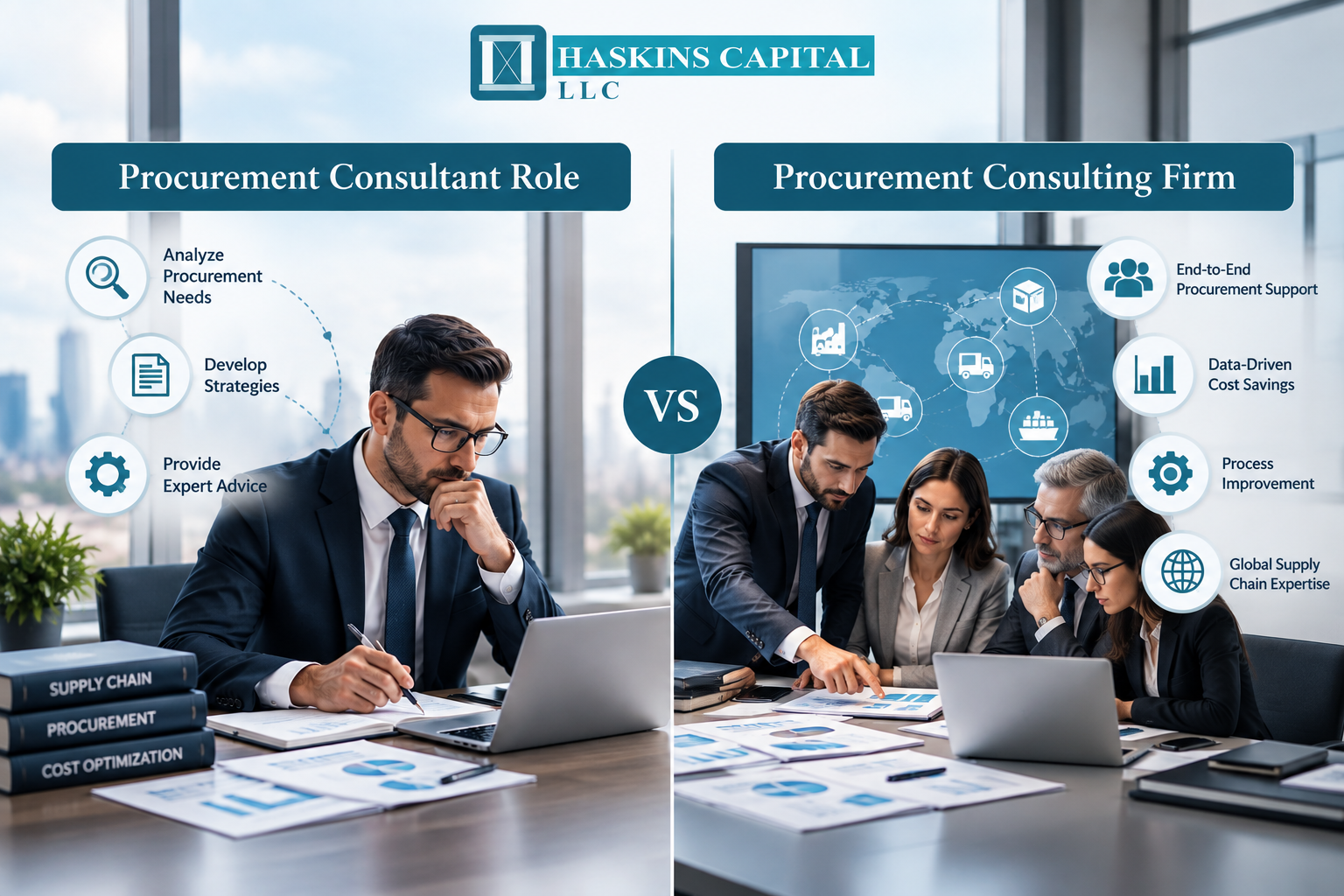
When seeking commercial support, organizations must choose between hiring an independent procurement consultant or engaging a traditional procurement consulting firm. Large consulting firms typically deploy teams of generalist analysts who utilize standardized, high-level frameworks focused on indirect corporate spend. These engagements often come with high overhead costs and monthly retainers regardless of results.
In contrast, an independent procurement consultant or specialized advisory practice brings direct operational leadership to specific projects. At Haskins Capital LLC, clients work directly with senior owner-side experts like Steven L. Haskins, BSEE, MBA, who brings over 20 years of hands-on capital program leadership rather than junior account coordinators.
Procurement Consulting for Capital Projects (CapEx)
Most traditional procurement consulting firms focus on recurring indirect spend, such as software licenses, office supplies, or standard freight contracts. However, capital project procurement presents fundamentally different financial risks.
When executing a 5 million to 25 million dollar plus industrial facility build or machinery installation, purchases are infrequent and highly customized. Integrating procurement and project management ensures that major capital investments are protected through rigorous commercial gatekeeping. Capital project procurement consultants specialize in bottom-up should-cost modeling for custom equipment, auditing contractor change orders against physical field progress, and enforcing strict pay application controls before funds leave the building.
How Procurement Consultants Get Paid
Understanding consultant fee structures is critical for owners evaluating outside advisory support. Procurement consultants generally operate under one of three pricing models:
- Hourly Billing: The client pays a fixed rate per hour worked, which can lead to unpredictable total costs and no guarantee of savings.
- Fixed Retainer: The consultant charges a set monthly fee regardless of project outcomes or realized cost reductions.
- Performance-Based Pricing: The consultant earns fees based directly on documented, realized savings achieved for the client.
Haskins Capital LLC uses a performance-aligned pricing model consisting of a low-risk baseline engagement fee paired with 15 percent of documented, realized savings. Clients retain 85 percent of every dollar saved, ensuring complete commercial alignment.
End-to-End Procurement Consultants vs. Specialized Review
Organizations do not always require broad, multi-year engagements from end-to-end procurement consultants. While full-scope consulting covers category management, strategy development, and vendor sourcing from initiation to closeout, many companies only need targeted risk intervention.
Specialized reviews focus on high-risk inflection points, such as auditing a single high-dollar equipment contract or gatekeeping mid-project change orders. For example, Haskins Capital LLC offers an entry-point 497 dollar commercial risk review that audits specific capital agreements against a 30-point checklist before execution.
Procurement Advisory Service vs. an In-House Procurement Team
Building a permanent in-house procurement team creates ongoing payroll overhead that may not be justified for periodic capital projects. Plant managers and internal engineering teams are frequently forced to oversee multi-million-dollar facility expansions on top of daily production quotas, leaving them without the bandwidth or market benchmark data needed to verify supplier quotes.
Engaging a procurement advisory service provides scalable, executive-level commercial governance on a fractional basis. Asset owners gain objective, third-party oversight during major capital allocations without adding permanent headcount to their payroll.
When to Hire a Procurement Consultant
Organizations should evaluate external procurement support when specific project triggers indicate financial exposure. Common signs include:
- Contractor change orders are frequently submitted without line-item verification or market rate audits.
- Progress payments are authorized based on contractor self-reporting without verifying physical work-in-place.
- Capital equipment quotes are accepted without bottom-up should-cost modeling or market benchmarking.
- Internal project teams lack dedicated owner-side procurement experience for major facility builds.
Frequently Asked Questions
What is the highest paid type of consultant?
Specialized commercial and technical consultants who deliver direct, measurable financial results command the highest rates in the industry. In capital project procurement, advisors who specialize in high-dollar CapEx risk mitigation and performance-based cost reduction generate substantial value by protecting multi-million-dollar budgets.
What is procurement?
Procurement is the strategic process of sourcing, negotiating, acquiring, and managing the goods, services, and equipment an organization needs to operate. It encompasses contract governance, supplier management, cost control, and financial risk mitigation.
Talk to an Independent Procurement Consultant
If you are planning a major capital build or suspect your current equipment proposals and contractor change orders contain unearned margins, independent owner-side oversight protects your bottom line. Haskins Capital LLC provides targeted commercial governance, from a 497 dollar entry-point contract risk review to full fractional program oversight. Schedule a free 30-minute discovery call at haskinscapital.com to benchmark your project risk today.